Posts

Showing posts with the label Steve Ditko

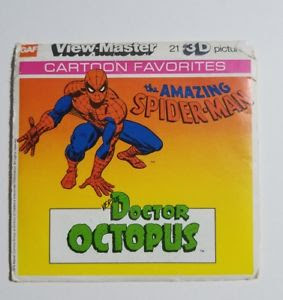
View Master Spider-Man, Hulk, and a downtime story of the world's strongest man.
Image
My recent date at Putt Putt made me remember my visits there in 1981. Thinking of those times has taken me back to a special day that year. Dad asked if I'd like to go somewhere, just me and him. Off we went that afternoon to Riverbend Mall, during a spell his sister and her three kids – four, there was a baby!- had moved in with us. Mom thought I might be lonely to get a bit of Dad’s attention- I probably said as much, knowing me. I cried over garbage when I was three, because the things in the rubbish bin would no longer be part of our life, and wouldn't they be sad, to not be wanted anymore? > Here's the original page that inspired most of the Reel B battle, set up with Doc's tragic origin and Spidey's mysterious, almost sinister peep into the facility before the battle at the end of Reel A. I clicked through the story, bereft of Stan Lee’s script and captions, funky and quirky drawings so different than the usual commercial way I saw Spidey represe...

End of Spider-Man

Image
The End of Spider-Man Two degrees and a lifetime living away from my hometown later, I still find Amazing Spider-Man, by Stan Lee, Steve Ditko, and John Romita, eminently readable. Even when I want to strangle Peter for behaving anti-socially, there’s something in either alter ego that draws me cozily back up to those original issues. I read much of the last year of Ditko’s run and the first year of Romita’s- reprinted from 1965 and 1966- when I faithfully collected Marvel Tales. I’ve never owned it, myself, but my absolute favorite was a 1964 issue where Spider-Man becomes the first costumed adventurer to try, out of his sense of responsibility, to hang up his super-hero career. What an inversion of formulaic comics! I was maybe eleven when I read that one; I borrowed it multiple times, a worn back issue with a rolled spine. That battered 1983 reprint left one of my strongest adolescent memories. I can still smell the near-century-old elementary school building on whose ...

Spider-Man: Homecoming villain, the Vulture: 10 Key Stories of Spidey's Feathered Foe, and more!

Image
The second issue of Amazing Spider-Man, cover dated May, 1963, featured the wall-crawler’s first super-powered enemy. A conflict of youth versus age, the Vulture was an inventor who used his then-rare advantage to become a daring thief. The second story in the issue introduces another villain featured in Spider-Man: Homecoming- The Tinkerer, another rogue inventor, played by Michael Chernus. Courtesy USA Today His post-retirement plans were quite a bit more exciting than a 401 K and a house in Florida. We’re still so early in the Marvel Age at this point, a foe whose power was, primarily, flight and strength, makes a formidable challenge- maybe not as imaginative as what is to follow, but a nice use of visual and a great combatant for the neophyte wall-crawler. As super-villains go, The Vulture was not a bad start. For one, he makes a terrific test of Spider-Man’s new combat skills, as dizzyingly depicted by co-creator Steve Ditko. His technology-based abilities provide an obs...

Complete the Series: the end of Machine Man's first run

Image
Might I say, Frank Miller and Terry Austin knocked it out of the park on Machine Man's last cover. For a change, the creative team knows it's the end and try their best to wrap things up. I don't want to give away too many spoilers, but this issue marked a turning point for Machine Man's disguised civilian life at DelMar Insurance. There's a super-embassy, designed to withstand a terrorist attack by sealing the occupants within and relying on high technology security. A huge Halloween party is the chosen way to showcase the embassy for interested parties. Masks have reached a crisis point for Machine Man; his face has been ruined during his battle with Alpha Flight, but his facade of humanity both seems to be leading him into confusion with Pamela Quinn and repudiation in the form of violent blackouts, as began when fighting Madame Menace and the revolutionaries in #17. Machine Man has to get to the bottom of his behaviors while dealing with the debut of the Jac...

Arms and the Robot!

Image
“Arms and the Robot !” Machine Man’s search is interrupted by the remnants of Brimstone’s Satan Squad; the first of many fights ensues. At the end, he’s no closer to the arm...which is in the hands of a skeevy sort who’s taken it to minions of Madame Menace. The robot arm impresses them, so they send the signal to coy Sunset Bain, who flirts and suggests to a senator her real story would shock him. She leaves the party in his hands, and comes to examine her blindfolded visitor. She offers a thousand for the arm, and he wants twenty. The flesh-eating roach they’re working on is his cue to take what he can get. Like the Corporation, someone else sees a super=weapon to mass produce on the market, perhaps in components. Like Kublai Khan, someone else wants his body for profit. Gears and Spalding banter, while MM decides there’s no choice but to find his irreplaceable arm. He disregards advice to “listen to Billy Joel...or plug into the Carson Show!” He decides to take a cue from T...

Sunset Bain and the Machine Man to come

Image
Then the hand culminates in a finger pointing to the credits. Genius. This is probably my favorite Ditko splash page of his run; the arm is the border against pitch blackness, representing the lost limb that carries the plot ---straight to Madame Menace. There’s a terrific metaphor---the hero sacrifices his arm for one person he finds worthy and inspirational---then his arm becomes subject the attentions of greedy manipulators who want to sell the value of his arm to the highest bidder. Whoever thought up the plot could’ve been talking about Kirby, or many others besides, and if it was Ditko, it has a nice Randian subtext while maintaining the crackle of a superhero adventure. Machine Man searches the area of his battle (near the cathedral last issue) but gets no signal from his detached arm. He checks in on Pamela Quinn, who finds him cold and unemotive but senses something mysterious beneath that...as well as a touch of déjà vu, like she knows him. The next-to-last piece of MM’s ...

An early homage to the Silver Age of Comics

Image
It is arguable that everything in the Marvel Age of Comics is a type of homage to the intense period of activity and creative excellence of Stan Lee, Steve Ditko, and Jack Kirby. With these late issues of Machine Man, we have the pure Kirby character creation, drawn by Steve Ditko, and then scripted, edited, and presented in a style reflective of Stan Lee, with Tom DeFalco and Denny O'Neil as writer and editor. Some might call it a version of a microcosm of the actual creative breakdown: one character creator, separated from the final product sometimes by an additional artist, and then an editor/ scripter, packaging and presenting rather than demonstrating raw creative ideas, but instead, ideas about communicating them. That is one fundamental assessment of Marvel's creative history, and not the only one. The precise elements of the synthesis are a puzzle attended by many longtime fans. By 1980 comics were a little different than they'd been in 1964-1966, though establi...

Ditko draws a Master of the Mystic Arts!

Image
“Baron Brimstone and his Sinister Satan Squad!” A Journey into Far Out Fantasy by Tom DeFacto and Steve Ditko w/Bob Sharen, D. Albers, Denny O’Neil, Jim Shooter Stack and idiot co-worker Eddie Harris tour Chem-Solar Corporation as investigators for Delmar Insurance. Aaron notes to himself Eddie takes nothing serious outside of baseball scores. “A highly-amplified microwave transmitter” demonstration melts through a block of titanium. They believe it will lead to a break-through in powerful data transmissions across the stars. With a burst from his finger tips and a smile on his face, from the green smoke suddenly appears Baron Brimstone. Eddie mistakes a mock-evacuation for show for them, but Machine Man feels the fear and panic. His clothes are hidden quickly in his legs, and he’s racing up the side of the wall using gravity negation to pinpoint the uproar. Proclaiming himself a master of the mystic arts, Baron B evokes a bullet-deflecting shield, and then “a spell of slumber” ...

Countdown to new fiction Machine Man 15

Image
Basically a hard-working lady scientist devoted to alternative fuel. She can produce an "electro-magnetically charged gas---but I can neither confine nor contain it!" One power overload later, Dr. Violetta Todd transforms herself accidentally into a gaseous creature dubbed Ion. Machine Man's sent, as Aaron Stack, to investigate. His fight with her leads to his compassionate take and also, damage to his legs. (His repairs are an ongoing shtick in this series.) He's found by Gears Garvin, who enacts repairs and then mounts him atop a wheel, like a unicycle. Meanwhile Ion goes to the Fantastic Four for help. Only Ben and Johnny are home. The battle and wisecracks ensue. Machine Man finally uses his refrigeration unit to cool down the gaseous Ion and solidify her once more as a person. His battle with her has left him thoughtful. Everything from the splash onwards deliberately plays up the Silver Age of Marvel, which has a sensible aesthetic as a mode for DeFalco ...

Xanadu: conclusion Classic Machine Man adventures

Image
All art Steve Ditko! [img]http://i51.tinypic.com/2dgmjjb.jpg[/img] Machine Man battles laser-firing rockets in a maze, which he tests for structural integrity. He uses the weakness in the floor (it’s dirt ground) to spin and become a living drill, to resurface outside. The sonic pitch pains him again, leading him to Khan’s Xanadu in the dark clouds. Machine Man’s been tormented someone he doesn’t know would do this, but now he knows his foe. [img]http://i51.tinypic.com/2sagwtl.jpg[/img] “Steel smashes its way through steel” and our motivated metal marvel shoves his way into the dirigible---and an attack by Tong, who feels no pain due to surgery and possesses super human strength. “Tong has been shown how to temporarily deactivate your internal mechanisms,” Khan raves, before ‘Tong’s rendered Machine Man “unconscious.” [img]http://i54.tinypic.com/148pvgn.jpg[/img] Quickly now he’s thrown on to a table alongside the babbling villain for the mind/ body switcheroo. Machine Man rises ...

Xanadu: from the classic Machine Man adventures

Image
MACHINE MAN #13 Writer/ Editor Marv Wolfman Artist Steve Ditko Letters Irv Watanabe Colors George Roussos Consulting Editor Jim Shooter “Xanadu!” (Our cover has another building; any of my budding artists willing to try that building under construction?--Uncle Lue) Machine Man’s gotten the shaft: an elevator plunges towards him as his telescoping limbs hold in place before the crushing blow. He works a little classical physics and struggles while being observed on a screen in the chambers of Khan, who's now referred to as Kublai Khan. He and manservant Tong observe Machine Man's stubbornness. He's resourceful, too; he reaches down to the generator engine, taps into it, and creates a repellent magnetic charge. Khan's pleased; he has superior intelligence, he says, but a useless, obese body. Machine Man might become his answer! He checks in on Gregarian, "finest sculptor in Vienna"; Khan honors his warrior pose "best work to date!" wit...

Layout challenge Part 1: Ditko

Image
Powered by WebRing . This site is a member of WebRing. To browse visit Here . So, to start off my layout challenge, I began drawing the shapes in the first two panels. I started adjusting, to deal with the overall page proportions. I actually worked on the last panel last. This process of darkening parts of the figure---to give the figure or object density---is referred to as "spotting blacks." It's the inker's job to fill these areas completely. Here's about twenty minutes devoted to laying out page two of our spread: So you can see it's on there rather lightly. Then I'd come back and give it more definitive form, like the first page!`~ C Lue Lyron

Xanadu: a challenge in layouts

Image
Here you see two different products inspired by Jack Kirby's Machine Man comics published by Marvel Comics between 1977 and 1978. One is Marvel's professional continuation of the science fiction hero in more of a straight super hero treatment, and the action is as close to Spider-Man as possible. Marv Wolfman is also writer and editor of the Amazing Spider-Man at this point in time. His partner here, Steve Ditko, is credited with having created the idea behind many issues of Amazing Spider-Man, and drew the wall-crawler from his first appearance in 1963 until 1966. This is the second time Steve Ditko followed Jack Kirby on a title, counting the Hulk during 1962 to 1965. This character is solely created by Jack Kirby, who deliberately chose to work on titles mostly of his own creation, after stints on a revival of the Black Panther and a run as writer/editor/ artist on his old creation with Joe Simon in 1941, Captain America, and just in time for America's bicentennial. S...

Bright spirits

Image
This is a strange story, by Marv Wolfman and Steve Ditko. It's about Machine Man helping out mankind while remaining feared; indeed, one thing after the next vexes him as he observes our criminality and distrust and callousness. He releases a powerful bolt while hovering in the sky, and this discharge drifts into the windows of six people, initiating a biochemical acceleration in their evolutionary state. Now far advance of human kind (perhaps a million years), they take Machine Man down, fighting. They circle him and prepare for judgement---much to his anger and dismay. They hear the voice of a child of a man he's saved just now from an embedded bullet (he was shot during a robbery just stopped by Machine Man in the first pages). He believes in Machine Man's good, even if Machine Man's frustrated and embittered. They release him. Too far advanced for life on Earth, they decide to play silent benefactors, destined to return, to watch over Man. For now, however...